How Much Are My Medals Worth?: Sell My Medals
How much are your military medals worth? Discover how rarity, condition, the recipient and historical records affect medal values in our guide.
Updated 29 October 2026
How Much Are My Medals Worth? A Guide to Military Medal Valuations
If you have inherited military medals, discovered a family collection or collected medals over the years, you may be wondering: how much are my medals worth?
The answer depends on much more than the age or appearance of a medal. Its historical importance, rarity, the person who received it, its condition and the availability of supporting records can all influence its value.
Some medals are relatively common and may have modest collector value. Others are highly sought after because they relate to a particular campaign, regiment or act of bravery. A group of medals awarded to one individual can also be worth more than the individual pieces considered separately, particularly when their history can be established.
In this guide, we explain the main factors that affect military medal values, how to research a medal's background and what to do if you would like to find out what your collection might be worth.
What determines how much a medal is worth?
There is no single price that applies to every medal of the same type. Two medals that look almost identical can have very different values because of their recipients, service histories, condition or rarity.
When assessing a military medal, collectors and specialists commonly consider the following factors:
- Rarity: How many examples were issued, and how many are believed to survive?
- Recipient: Can the medal be linked to a particular serviceman or servicewoman?
- Historical significance: Does it relate to a notable campaign, battle, event or act of bravery?
- Condition: Is the medal well preserved, with its original details, ribbon and fittings?
- Originality: Has it been altered, repaired, renamed or assembled from different components?
- Provenance: Are there documents, photographs or other records that establish its history?
- Collector demand: How much interest is there in this type of medal or the person who received it?
These factors work together. A medal might be scarce but attract limited demand, while a more familiar award could be highly desirable when it has a particularly interesting history.
The four different types of medal value
When asking how much your medals are worth, it helps to understand that the word “value” can mean several different things.
1. Collector or market value
This is usually the most relevant figure if you are considering selling your medals.
Collector value reflects what a buyer may reasonably be prepared to pay in the current market. It depends on demand for the award, its condition, rarity, historical background and the strength of its supporting evidence.
Recent comparable sales can provide useful guidance, but the prices achieved for other medals should be treated carefully. The circumstances behind each award and the details of each recipient can make a substantial difference.
2. Insurance or replacement value
Insurance value relates to the cost of replacing a comparable medal or collection if it were lost or damaged. Finding a suitable replacement may involve searching specialist dealers or auctions, and the replacement cost can differ from the amount you might receive if you sold your own medal.
If you need a valuation for insurance purposes, explain this when approaching a specialist. A selling estimate and a formal insurance valuation are not necessarily interchangeable.
3. Sentimental value
A medal passed down through a family may have enormous personal significance. It might be connected to a grandparent, a relative who served during wartime or a family story that has been preserved for generations.
Sentimental value is personal and cannot be measured in the same way as market value. You may decide that keeping a medal is more important than selling it, even if it has an established collector value.
4. Bullion or metal value
Some medals contain precious metals, but their value as historical objects can be far greater than the value of their raw materials.
A medal's metal content, weight and purity may be relevant, but it is rarely sensible to assume that its worth is simply the value of its silver or gold. Its historical identity, original features and connection to a recipient may be central to its appeal.
Important: Do not clean, polish, dismantle or melt a medal to try to improve its value. Such actions can damage original surfaces and remove details that collectors consider important.
Does the type of military medal affect its value?
Yes. Different categories of medals attract different levels of interest, but the category alone cannot tell you what an individual example is worth.
Gallantry and bravery awards
Decorations associated with acts of courage can attract considerable collector interest. Examples include the Victoria Cross, George Cross, Military Cross, Distinguished Conduct Medal and Distinguished Flying Cross.
However, the value of a particular decoration depends on its individual history, the recipient and the circumstances of the award. A documented decoration associated with a notable action may be valued very differently from another example of the same award.
Campaign medals
Campaign medals recognise qualifying service during a particular conflict or operation. British and Commonwealth examples cover many periods, from nineteenth-century campaigns through the First and Second World Wars to more recent service.
Some campaign medals were issued in substantial numbers, meaning an ordinary, unidentified example may have a relatively modest market value. Clasps, entitlement, recipient details and historical context can make a difference.
Long-service and good-conduct medals
These awards recognise particular forms of service, conduct or commitment. Their value may depend on the exact award, the service branch, the period of issue and whether the original recipient can be identified.
Medal groups
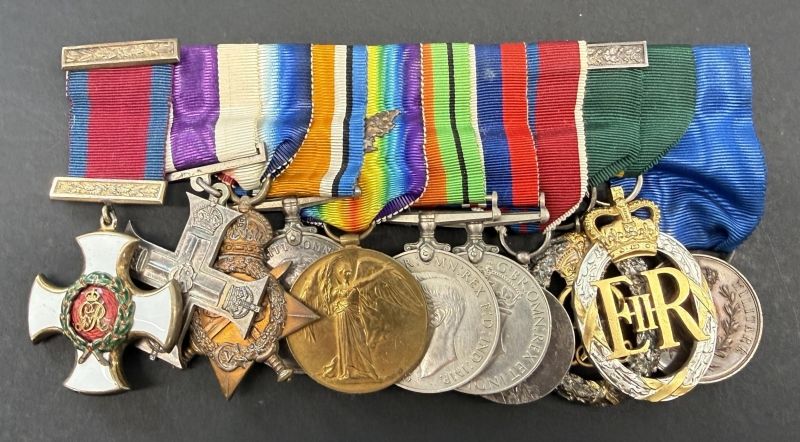
A group of medals awarded to one person can be especially interesting to collectors. Keeping the medals together may preserve evidence of an individual's service across different campaigns or stages of their career.
Before separating a group, it is worth having the collection assessed as a whole. The relationship between the medals can be an important part of their historical and collector value.
Why the recipient's identity can make such a difference
One of the most important steps in military medal valuation is establishing who received the award.
Some British military medals have the recipient's name, rank, service number or regiment engraved or impressed on the rim. These details can provide a starting point for researching the individual's service.
Other medals, including many Second World War campaign stars, were issued without personal naming. In these cases, family records, original packaging, photographs and service documents may help connect the medals to a particular person.
Research can sometimes reveal details such as:
- The recipient's regiment, battalion, ship or service branch.
- The campaigns or theatres in which they served.
- Whether they received a gallantry award or other official recognition.
- Whether they were wounded, became a prisoner of war or died during service.
- Whether their unit took part in a notable engagement.
A medal does not automatically become more valuable simply because a recipient can be identified. However, reliable evidence can help establish its history and may reveal details that make it more desirable to collectors.
Where can you research a medal recipient?
Several established resources can help you investigate a medal's background:
- The National Archives: British military campaign and service medals — guidance on medal rolls and service-related records.
- The National Archives: British military gallantry medals — information about researching bravery awards, citations and official announcements.
- The Gazette — a useful resource for searching official award announcements and other public notices.
Records are not available for every individual, and some searches require additional information or access to specialist archives. Even an unsuccessful search does not necessarily mean a medal lacks value.
How much does the condition of a medal matter?
Condition is another important consideration when estimating how much a medal is worth.
Collectors often look closely at the medal's surface, lettering, edges, suspension, ribbon and any accompanying clasps. They may also consider whether the medal appears to retain its original finish and components.
Things worth checking include:
- Surface wear: Are the raised details and inscriptions still clear?
- Edge damage: Are there dents, deep scratches or other knocks?
- Ribbon condition: Is the original ribbon present, and how well has it survived?
- Clasps and fittings: Are the expected components present and in apparently original condition?
- Alterations: Are there signs of repair, polishing, replacement parts or changes to the naming?
- Storage damage: Has the medal suffered from damp, corrosion, heat or other damage?
Wear does not automatically make a medal undesirable, particularly if it is an historically important example. Equally, a medal that looks attractive is not necessarily rare or valuable.
Avoid trying to restore a medal before having it assessed. Cleaning products, abrasive materials and attempts to remove tarnish can cause permanent damage. It is generally better to preserve the medal as you found it.
Do original ribbons, boxes and paperwork increase medal value?
They can, depending on the medal and the evidence involved.
An original ribbon, clasp or box of issue may help preserve the medal's completeness and provide useful context. However, the importance of these items varies between awards, and replacement or associated items should not automatically be assumed to be original.
Paperwork can be particularly useful when it establishes a credible link between the medal and its recipient. Relevant material might include:
- Official award certificates or citations.
- Service records and medal entitlement documents.
- Original photographs of the recipient.
- Letters, diaries or personal accounts.
- Documents showing the recipient's rank, regiment or unit.
- Family records that help explain how the collection was passed down.
A photograph of the recipient wearing the medals, for example, may help support an identification. Documents relating to a specific act of bravery may also provide valuable historical context.
Keep all associated paperwork with the collection, even if you are unsure whether it is relevant. A specialist may recognise its significance.
Can renamed or altered medals affect their value?
Yes. The naming and originality of a medal can be important to collectors.
Some medals were officially named or engraved, while others were issued without a recipient's details. Over time, medals may also have been repaired, modified or had components replaced.
If the name on a medal appears unusual, inconsistent or altered, do not attempt to investigate by scraping, polishing or otherwise modifying it. Changes can be difficult to identify with certainty from photographs alone.
Instead, photograph the medal clearly and ask a knowledgeable specialist to examine it. Any concerns about naming or originality should be considered alongside the medal's type, provenance and wider history.
Are rare medals always worth more?
Rarity can be a major factor, but it is not the only one.
A medal might survive in very small numbers yet attract limited interest from collectors. Another award may have many surviving examples but command stronger demand because of its historical importance, recognisable design or connection to a popular collecting area.
For example, decorations associated with exceptional bravery can attract substantial interest, particularly when the recipient and circumstances of the award are well documented. Certain campaign medals can also be desirable when they feature scarce clasps, unusual entitlement or a connection to a notable individual.
The key question is not simply how many medals were issued. It is how scarce the particular example is, what makes it distinctive and whether collectors are actively seeking it.
How can I estimate the value of my medals?
If you want to research your collection before requesting an assessment, the following steps can help.
Step 1: Identify each medal
Look for the medal's name, design, date, inscription and any visible details around the rim. If you cannot identify it confidently, take clear photographs of both sides rather than guessing.
Step 2: Record the recipient's details
If a name, rank, service number or regiment is present, write it down exactly as it appears. Even small differences in spelling or numbers can matter when searching historical records.
Step 3: Photograph the complete collection
Take photographs of the front and reverse of each medal, along with the ribbons, clasps, boxes and any paperwork. Include close-ups of inscriptions and edge naming where possible.
Step 4: Research the recipient and award
Use reliable historical records to investigate the person's service and medal entitlement. The National Archives and The Gazette are useful starting points for many British military awards.
Step 5: Compare relevant sales
Look for completed sales of comparable medals rather than relying solely on asking prices in online listings. Make sure the comparisons are genuinely similar in terms of award, recipient, condition, provenance and included items.
A sale price for a different recipient or a particularly famous group may not be a realistic guide to your own medal's value.
Step 6: Seek a specialist assessment
If you remain unsure, an experienced medal specialist can consider the details together. This can be particularly helpful for inherited groups, older campaign medals, potentially rare decorations or collections accompanied by historical documents.
Are military medals a good investment?
Military medals are primarily historical objects collected for their associations with individuals, regiments, campaigns and significant events. Some have achieved strong prices over time, but that does not mean every medal will increase in value.
Collector demand can change, and individual prices depend on factors that cannot always be predicted. Buying medals solely in the expectation of a financial return therefore carries uncertainty.
For many collectors, the appeal lies in preserving and understanding the stories behind the awards. For someone who has inherited a collection, learning about the recipient can be just as important as establishing its market value.
If you are considering selling, focus on understanding what you have, keeping any supporting evidence together and obtaining an informed assessment before making a decision.
How much are my medals worth? Get help with a valuation
The value of a military medal can rarely be established from its appearance alone. Its exact type, recipient, condition, originality and historical background all need to be considered.
If you have medals you would like to sell, Sell My Medals can help you take the next step. You do not need to identify every medal yourself or complete all the historical research before making an enquiry.
Visit our Sell Your Medals page to tell us about your collection. Clear photographs and any information you have about the recipient can be a useful starting point.
Whether you have a single campaign medal, a group inherited from a relative or a collection you have built over many years, getting the right information is the first step towards understanding its potential market value.
Frequently asked questions about military medal values
How much are my medals worth in the UK?
There is no standard price for military medals. Values vary according to the award, rarity, recipient, condition, provenance and current collector demand. A specialist assessment is the best way to consider these factors together.
Are old military medals valuable?
Age alone does not determine value. Some older medals are highly desirable because of their rarity or historical significance, while other examples survive in greater numbers and may have more modest collector value.
Are unnamed medals worth anything?
Yes. An unnamed medal can still have collector value, depending on the award, condition and demand. If it can be reliably linked to a recipient through family records or other documentation, that information may also be relevant to its assessment.
Do medals with their original ribbons sell for more?
Original ribbons and other components can contribute to a medal's completeness and appeal. Their importance depends on the specific award, the condition of the items and whether they appear to be original.
Should I clean my medals before selling them?
No. Cleaning or polishing can damage the original surface and reduce collector appeal. Leave the medals as they are and seek advice before attempting any restoration.
How can I find out who my medals belonged to?
Start with any names, service numbers, ranks or regimental details on the medals. You can then investigate relevant medal rolls, service records and official award announcements. Photographs and family documents may also help establish an identification.
Is a medal group worth more than individual medals?
It can be. A group awarded to one person may tell a more complete story of their service, and keeping it together can preserve its historical context. The value depends on the individual awards, recipient and supporting evidence.
Can I sell medals if I do not know their history?
Yes, you can make an enquiry even if you have little information. Photographs and any details you do have can help a specialist begin identifying the medals and considering their potential value.
Want to find out what your collection could be worth? Visit Sell My Medals to enquire about selling your military medals.